Our digital well-being matters. It is best to disconnect when needed and create healthy habits for the whole family.

Originally posted at the Sunday Business & IT on October 14, 2018

Are you guilty of reaching for your phone every time you wake up in the morning to check on your notifications? I do and it has become a habit ever since I got hooked on social networking sites as early as 2007.

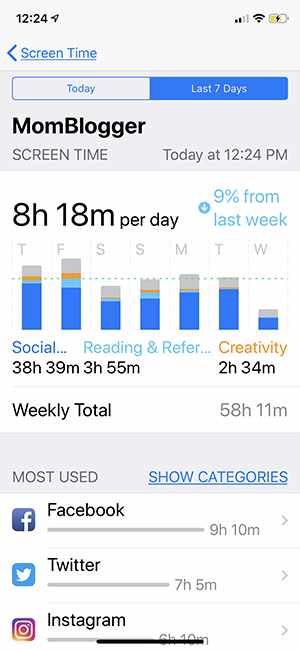
Screen time from another weekly period

Proof? I spent 56 hours and 37 minutes on my iPhone for the last seven days or an average of eight hours and five minutes per day. My husband overheard me exclaim as I read the Screen Time statistics on my iPhone. He comforted me with “That’s part of your job.” Sure, I am a social media practitioner and citizen advocate rolled into one. I love to curate news articles, share photos and updates or opinions from my five blogs. It is time to audit and check if my usage is too high or excessive for my work. Is it time well spent? My Fitbit app tells me I slept an average of seven hours and a half the past week. That leaves eight hours and a half for my laptop use and other activities such as driving, walking and meeting people.

The latest iOS 12 features the Screen Time tools which show up under Settings > Screen Time. This provides an iPhone user with iPhone 5 and above to find out the time spent and limit apps’ usage. The first thing I do is to check the Screen Time report, a bar graph that illustrates the time spent on my iPhone during the day or in a week. One can see the breakdown of the time spent on specific apps. Try it. My latest weekly screen report showed:

1. Social networking — 37 hours and 56 minutes (Facebook, Twitter, Instagram, messenger, Messages, LinkedIn, Telegram, Viber, WhatsApp, Local, Bubbly, Skype, Quora, Tumblr, Signal)

2. Reading & Reference — 3 hours and 54 minutes (Safari, Waze, Angkas, Online news)

3. Creativity — 2 hours and 34 minutes (Lightroom CC, camera, photos, Snapseed, Boomerang, GoPro, Unfold, Insta360Nano S)

4. Others — 2 hours and 24 minutes (browsing, shopping apps)

5. Productivity — 1 hour and 40 minutes (Gmail, Drive, calculator, Calendar, One Note)

6. Entertainment — 1 hour and 4 minutes (Spotify, Youtube, Oculus)

7. Health & Fitness — 19 minutes (Fitbit, Nike)

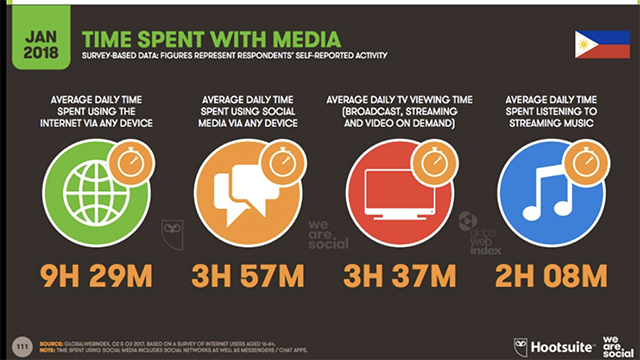
In the WeAreSocial Global Digital Report for January 2018 in the Philippines, the average daily time spent using the internet via internet device is nine hours and 29 minutes. Average time using social media spent via any device is three hours and 57 minutes. While my total screen time is lower than the average, I spend over four hours on social media. I was alarmed by the data. After seeing I use 15 social networking apps, I decided to prioritize them.

Using the Screen Time tools, I limited the average one hour time on Facebook to 30 minutes a day. I did not set limits on Twitter. My number one platform for social media engagement is Twitter because fewer trolls thrive in this network. Thirty minutes in Facebook is not adequate during a busy news day.

iPhone users can use the “Do Not Disturb” function that lets you turn off your notifications and calls.

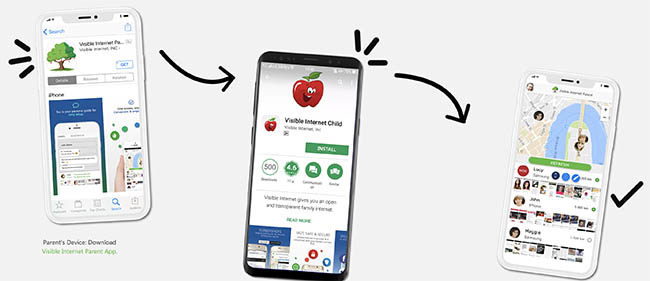
The “Downtime” feature allows you to do the same for apps. Parents can manage their kids’ screen time and impose app limits on them remotely. To use Screen Time for tracking and managing your kids’ device usage, the parent must add them to their iCloud Family Sharing account. Google initiated its “Digital Wellbeing” app, which is in beta preview for Pixel devices. Facebook and Instagram rolled out digital well-being features that include an activity dashboard, a daily reminder, and a new way to limit notifications.

Although I’m committed to using technology in advocating change for social good, my digital well-being stays front and center. There is a concern about the blue light from digital devices which allegedly can damage vision and speed up blindness. Based on an optical chemistry research at the University of Toledo in the US, “blue light from digital devices and the sun transforms vital molecules in the eye’s retina into cell killers”. Dr. Ajith Karunarathne, an assistant professor in chemistry and biochemistry in the university said: “We are being exposed to blue light and the eye’s cornea and lens cannot block or reflect it”. The research published at the peer-reviewed journal Scientific Reports added, “It’s no secret that blue light harms our vision by damaging the eye’s retina. Our experiments explain how this happens, and we hope this leads to therapies that slow macular degeneration, such as a new kind of eye drop.” If you want to protect your eyes from blue light, Dr. Ajith Karunarathne’s advice is to avoid looking at your cell phones or other blue-light emitting devices in the dark and consider wearing sunglasses.

Our digital well-being matters. It is best to disconnect when needed and create healthy habits for the whole family.


The complete study can be found here.

First published at the Sunday Business & IT Of the Sunday Times entitled “Embracing the era of experience: Marketing redefined”

Do you recall the feeling when you purchased something for yourself? When I bought a pair of Nike shoes a few weeks ago, I felt good about my decision even if the price was higher than my budget. I did not just gain a high-tech midsole with the lightest, softest, smoothest, and most responsive foam Nike has ever produced. I bought the total fitness experience. Beyond the shoe, the brand understood a consumer’s fitness journey and complemented it with a Nike+ Training Club app. I felt more excited to carry out my Fitibit step goals together with this Ultimate Personal Trainer. This is one example of a brand that goes where their customers are. I find value in this great experience. One sees the rise of the “Experience Economy” when someone shares happy stories in social networks. It is experience embedded at every stage of the consumer journey.

The Digital Congress (DigiCon) for 2018, organized by the Internet and Mobile Marketing Association of the Philippines (IMMAP), tackled the Experience Economy (XE). The XE covered discussions beyond technology and mediums with a focus on creating an experience for the senses. Bozoma Saint John, a marketing guru and keynote speaker, reminded the delegates, “Emotion is the currency for the experience economy. We’re in the feelings business. We’re not in the data business.” If one is a marketer trying to build a business, one is talking about feelings most of the time. I love brands that understand my desires and recognize sentiments. Amazon is one company that understood my anguish when I complained that the cost of custom duties was more than the product itself. Instead of giving me a difficult time, Amazon gave me a refund. In their email, Amazon explained they valued my loyalty. It is no surprise I am still a loyal customer for over 10 years now.

experience economy

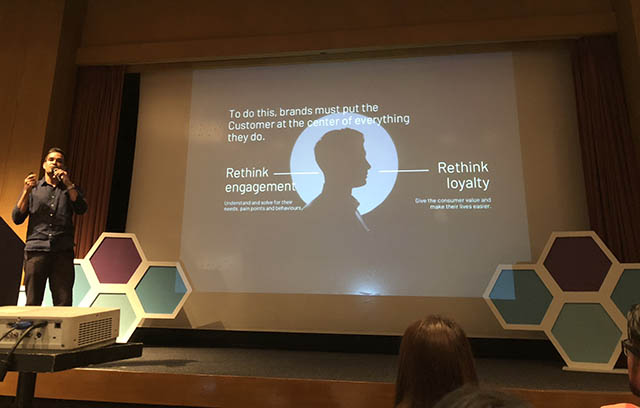
The Amazon shopping experience set my standard for the customer experience. I look up to brands who provide similar seamless interactions from every touchpoint. It is the touchpoints within the customer journey that help define both good and not-so-good moments. At DigiCon, Anthony Baker provided insights into the Experience Playbook. With access to reviews and competitive pricing, customers get more control in their choices. In the past, when a product is good, it will sell. That is not the case anymore. The shift is now toward customers driving brand experiences. It is about moving from marketing to experiences. This means putting the customer at the center and in everything they do. One must rethink engagement by understanding and solving their needs.

experience economy

Brands must get loyalty by giving the consumer value and making their lives easier. Amazon got my loyalty because I experienced being valued as a customer.

Customers connect with brands in the evolving digital landscape of the Web, Mobile, Social, Messaging, Augmented Reality/Virtual Reality/Mixed Reality, Voice, Artificial Intelligence, Machine Language, and Robotics.

Brands like Sephora, Nike, Alibaba, and Tencent are re-imagining consumer experiences. Value-added personalization services helped brands like Estée Lauder cut through the noise. Their chatbot finds the ideal consumer lipstick color for women. Some real estate companies use virtual reality in showing their future projects to potential customers. Mobile apps like the Nike Training app shape the in-store experience, empower the purchasing process, and create interesting and dynamic ways to interact with the customer.

experience economy

Baker suggests more points for a seamless brand experience:

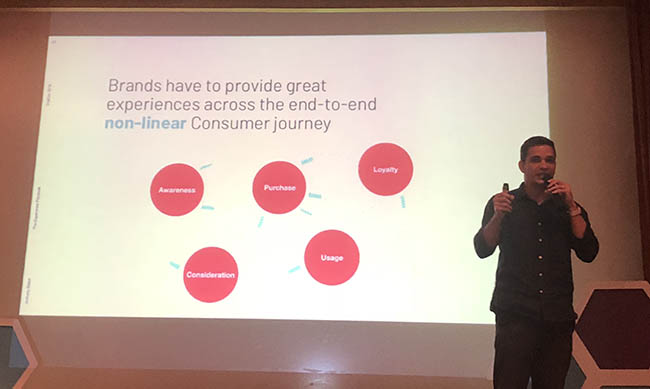
1. Brands have to offer great experiences across the end-to-end non-linear customer journey (awareness-consideration-purchase-usage-loyalty).

2. Think about engaging across the ecosystem, all platforms, channels, and screens.

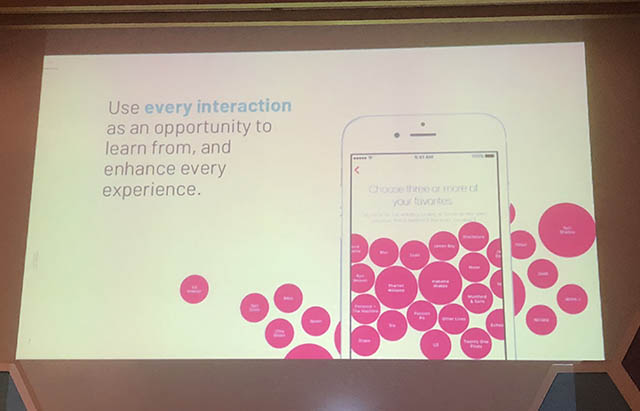
3. Use every interaction as an opportunity to learn from and enhance every experience.

4. Look beyond the transactions and focus on building long-term relationships.

5. Manifest the brand through the interface.

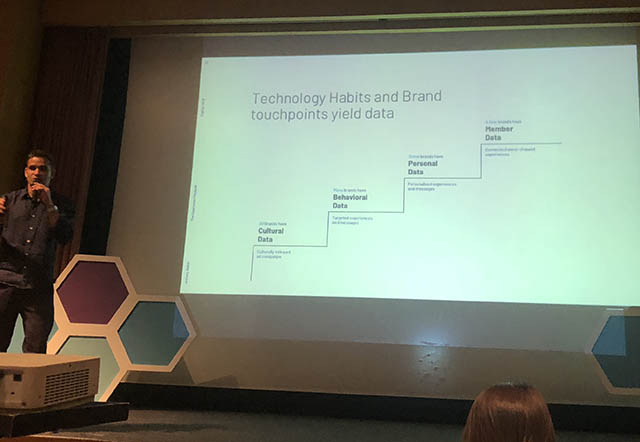
6. Brands must reclaim their consumer relationship and data. Brands that think of their consumers as members focus on the long-term relationship.

7. The model is now “inside out”. Every touchpoint has the potential for branded experience and engagement.

experience economy
Building customer loyalty is not enough. It’s about knowing, recognizing, anticipating, and creating value all the time and at scale. It is a promise that is compelling, clearly articulated, and makes consumers belong to something bigger. While I might not meet Nike’s promise of “We’ll make you a better athlete”, I know that I get value-added customer experiences through the tracking progress, encouragement, and clear routes to the improvement in my fitness journey. Consumers seek not only convenient service or a packaged product but a one-stop, sensorial experience.

Now is the time for business to embrace the era of experience.

First published at BYAHILO’S ERIC DORMIDO DIES AT 39 by Tonyo Cruz

Source of photo: Azrael

Eric Dormido, more popularly known as Byahilo, passed away today October 5, 2018. He was 39.

His sister Gladys Dormido said Eric was pronounced dead at 5:40 pm due to cardiac arrest at a clinic where he had his regular dialysis session.

Eric’s Byahilo.com is one of the country’s top travel blogs. He was one of the champions of local Philippine festivals, especially the Masskara festival of his hometown.

Eric was among the most prominent and most trusted bloggers, especially on tourism and travel. He received Readers’ Choice honors at the Philippine Blog Awards.

In 2009, Eric was one of the bloggers featured in an ad by Nokia, then the world’s top mobile phone brand.

News of Eric’s passing shocked the blogging community. Eric was still chatting with some friends as late as lunch time of the day he died.

“I always viewed Eric as a joyful person. So bubbly,” said fellow blogger Noemi Dado.

Another blogger, Berniemack Arellano, says that Eric was “passionate in his craft of street dance culture.”

Arellano wrote this message for Eric: “Padayuna ang pagsaut mo da sa pihak, geng! Kaupod mo na si Santo Niño! Salamat guid Eric Dormido Y Bravo sa aton nga pagululupod kag sinadya! I feel sad that you’ve gone ahead, but your presence will be in our hearts. I will not mourn for your departure, but I’d celebrate your life the way you like it, like the street dance festivals that you passionately love. DANCE IN PEACE, miga! Viva Señora Byahilo!”

He added: “I’d surely miss him, being the Festival Queen. I’d miss our talks and shared passion on festivals. I’d miss his antics. He may be gone, but his presence has been ever more greater. Dance in Peace, my good friend. Viva Señora Byahilo!”

Take a peak at Eric’s travel photos in his Facebook profile.

A native of Bacolod, Eric studied at La Consolacion College and University of St. La Salle.

Eric leaves behind his sister’s and brother’s families: Gladys, Terrence and Gab, and Crispin, Yasmin, Ysha and Bella.

Details of the wake, to be held in Sta. Rosa, Laguna, will be announced shortly.

Godspeed and happy travels in the great beyond, Eric.

In honor of Eric Dormido (Jan. 24, 1979-Oct. 5, 2018)


Having a break at Sunburst Mango. Heat was just too much. Sinulog, 2012

Nuffnang Talent Night, December 2012

With Francis Simsim, owner of Bluewater Day Spa, 2008

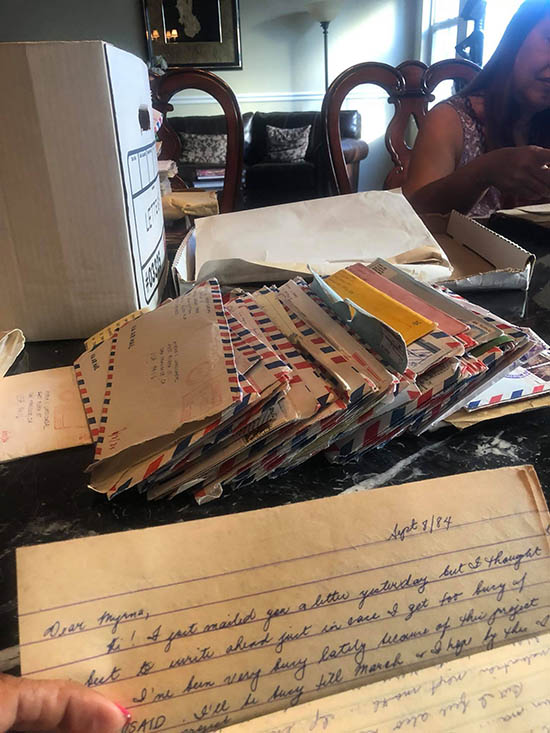
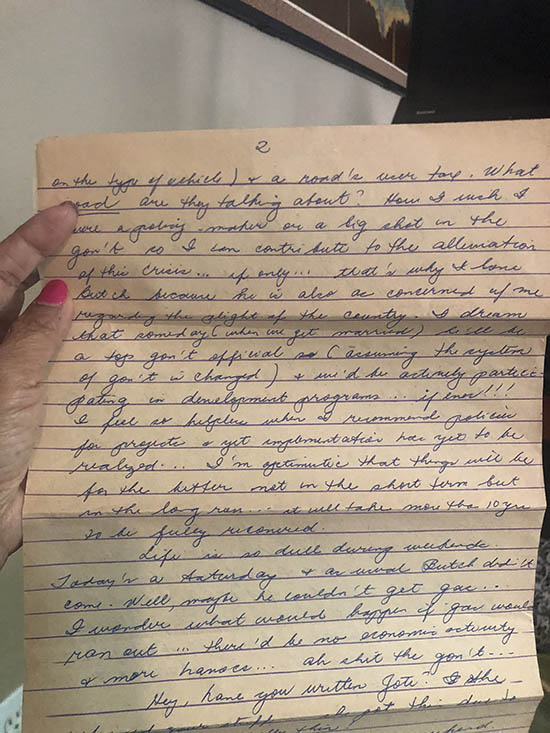
My sister Myrna  moved to the US in 1984, and I missed her so much that I often wrote long letters. I took a look at some of my letters and was surprised to read about how I also talked about the political situation in our country in 1984.

Allow me to share some snippets of a letter I wrote on September 1984 (Italics are current comments)

September 8, 1984 (about inflation and gas scarcity)

Dear Myrna,

I have managed to save 3,000 pesos but this is only worth 1,500 early last year. Well, it’s better to save than have no money at all. (Inflation Rate in Philippines averaged 8.41 percent from 1958 until 2018, reaching an all time high of 62.80 percent in September of 1984 )… It’s no joke buying food nowadays. 

There’s another bad news…gasoline supply until Thursday unless the government will give gas dealers a share of the tax included in the price of the gasoline…oh well, the government really worsens the situation by requiring additional taxes. There’s going to be an increase in taxes again— the vehicle registration tax (up by 200% to 600% depending on the type of vehicle) and road’s user tax. What road are they talking about? How I wish I were a policy-maker or a big shot in government so I can contribute to the alleviation of this crisis…if only…that’s why I love Butch because he is also as concerned with me regarding the plight of the country. I dream that someday (when we get married ) he’ll be a top government official (assuming the system of government is changed) and we’d be actively participating in development programs if ever!!!!? I feel so helpless when I recommend policies for projects and yet implementation has yet to be realized. I’m optimistic that things will be for the better not in the short term but in the long run…it will take more than 10 years to be fully recovered.

Today’s Saturday and as usual Butch didn’t come. Well, maybe he couldn’t get gas. I wonder what would happen if gas ran out..there’d be no more economic activity and more havoc…ah shit the government.

September 10, 1984 (Typhoon Nitang)

I continue to hear/read so many unfortunate incidents regarding Typhoon Nitang, such as

  1. a pregnant woman was found dead but lying on a tree (In Negros Occidental)
  2. A farm tractor (this is heavy) was found 5 kilometers away
  3. A betamax machine in Surigao was found 3 kilometers away. Of course, out of order
  4. Hospital with no roof in Surigao

There was so many unbelievable stories. The wind must have been so powerful almost like a tornado (remember Wizard of Oz). The government now has a good excuse for diverting present political/economic problems. As Marcos said “Let us think of our country first and ourselves, last”. Look who is talking. Everyday, donations come in.

In our house in Cebu, our garage roof and the roof of the  house for the workers were also blown away.

September 25 – on the September 21 rally

What is new here? I learned the bakeshop wasn’t operational for 9 days since they didn’t have water and electricity for days.

Well, heard about the September 21 rally? They threw water at the rallyists. The water came from the canal..yuk!.

Other disasters…Mayon Volcano eruptions and another earthquake in Ilocos.

September 28 on UP Barricade

Today and yesterday, UP was barricaded by students all over the entrances. I had to sleep over at Butch apartment for two nights because I had lots of work to do.

The present situation is really tense . I feel the tension around. Last night, while I was at Butch apartment, I listened over the radio about a violent rally at “Welcome Rotonda”. I knew Butch was there and it really made me nervous hearing all the casualties..some students were shot!. The son of Dean Nemenzo was even shot. Fortunately Butch arrived. What a relief. It has been violent since Sept 21.


As for Butch, he’s planning to go to Cebu this sem break. He’s planning to make pamanhikan this sem break. Hopefully. I feel so restless already. I want to settle down . I feel the need. But I also feel scared. What with another devaluation next month. If ever we get married, I’ll make it very very simple so that expenses are minimal.

-end of snippets-

All of these were sent in one email. There was so much happening in one month: the inflation, the scarcity of gas, the devastation of Typhoon Nitang, September 21 rally, the devaluation of the dollar, increase of road taxes. It was like writing a diary and sent in one mail.  I am looking forward to the other things I wrote during the Marcos regime. To be continued,

The article, 16 essentials smartphone apps for travel was originally published at the Manila Times.

During the Ninoy Aquino International Airport (NAIA) chaos, I had to rely on smartphone apps to make changes in my itinerary, check for airline status or help myself get comfortable while being stranded in an airport. I keep only a bare minimum of apps which have been helpful in my travels. These apps may also be useful in planning for your next trip.

1. Google Trips

Google Trips is like your “all in one” travel assistant because your plans and essential information are organized in one place, making it available even when you’re offline. Google bases the activity suggestions on your current location, travel reservations, flight details, tour itineraries and other information available in your emails from Gmail.

2. Booking.com

I use Booking.com, Expedia.com, and Airbnb.com when booking for accommodations, comparing prices or deals. Booking.com is my preferred app because some reservations do not require a deposit until a few days before the reserved date. I use Airbnb when I book for the family because some hotel rooms can’t accommodate over three family members.

3. Hopper

I normally purchase airline tickets directly from the company’s website because there is no significant price difference from online travel booking websites. Since my schedule has gone haywire, I am now checking Hopper which allows one to book flights and accommodations. The app even advises you if it’s good to purchase now or to wait. It informs or notifies you the dates when it’s likely cheapest to fly.

4. Google Maps

Google Maps are so useful when commuting abroad. One needs an internet connection to search transit directions using this app. Plan before you leave for the transit stops. You can find the list of train and bus departures from certain locations by selecting “transit” as the mode of transportation. Type “OK maps” on Google Maps to get an offline map of any location.

5. Priority Pass

Priority Pass allows you access to airport lounges worldwide. Your credit card company gives this to you or you can subscribe independently. Priority Pass proved useful when I had a 21-hour layover at the Hong Kong International Airport. With a membership card, lounge prices are discounted at half the regular rates. I could sleep on a comfortable lounge chair, get a quick shower, charge my gadgets, and enjoy a sumptuous buffet breakfast and lunch.

If you don’t have a membership card, there is LoungeBuddy for iOS where one can get a list of lounge locations, which you can access for free or for a onetime fee.

6. Flight Aware

Flight Aware allows you to track real-time flight status and tracking maps of any commercial airline anywhere in the world. One can view flights, which have been re-routed to a different terminal or airport. If you check a location, you can view the air traffic.

7. Flio

Before I encountered Flio, I downloaded a lot of multiple airport-related apps. The Flio provides you with a map, a boarding pass scanner, and directions to shuttle buses and booking options. It also allows you to receive updates about boarding times, gate changes and delays.

8. Trip Advisor

I take the reviews of a tourist attraction or accommodations in TripAdvisor with a grain of salt. Positive or negative comments are usually subjective but at least you can manage your expectations.

The Lonely Planet Guides have always been a good resource for travelers even before the days of the internet or travel apps. One can download a city guide for offline use.

10. Google Translate

Google Translate converts words, phrases, and short sentences from one language to another. There are so many features. The “Instant Camera” translation allows you to use your camera to translate text instantly in 38 languages.

11. Air Help

This app may come in handy if your international trip is cancelled, delayed, or overbooked. The laws differ based on where you’re flying. The thing is my airline was not directly at fault so this may not apply to my situation or the others affected by the NAIA chaos caused by the Xiamen Airlines’ crash landing last August 17, 2018.

12. AccuWeather

AccuWeather is great for planning since it features 15-day forecast summaries, 5-day forecasts, and an accurate, minute-by-minute weather forecast for the next two hours with MinuteCast.

13. Coins.ph mobile wallet

An SMS about a temporary deactivation for outgoing services reached me at the airport because I forgot to pay my bill. I could pay from my online banking website but it would take 24 hours for to reflect the payment. Fortunately, I had pesos in my Coins.ph wallet and access to public WIFI. The payment center is linked to the Bayad Center. Within minutes, I received another SMS that my payment was received and 15 minutes later, my line was reconnected. You can pay 80-plus service providers through this app.

14. XE converter

XE is your go-to currency app that provides you with the mid-market rate, thus acting as a benchmark to foreign exchange rate providers.

15. Splitwise

If travelling with friends, the Splitwise app makes it easier to calculate shared expenses. The app keeps a running total over time so you can pay each other back in one big payment instead of a bunch of small ones.

16. Skype

With the number of messenger apps, communication is faster. However, when I need to call the mobile or landline number of any customer support, a Skype credit or subscription is useful. Some Skype subscriptions allow you to text any mobile phone worldwide. The downside is that the recipient can’t text you back on Skype but on your mobile number.

The best apps for travel are the ones that give you convenience: real-time information, advice, insights, and warnings. Downloading the right apps will make your travel experience less stressful, smoother, and enjoyable. Bon Voyage!

This was originally published at the Manila Times on August 26, 2018

Travel is an adventure, I thought. However, when I had an eye-opening experience of a cancelled flight followed by a boarding delay of several hours, I could best describe it as “Noemi’s Chaotic Adventure”. The Ninoy Aquino International Airport (NAIA) runway closure due to Xiamen Air flight MF 8667’s crash landing exposed major weaknesses in NAIA’s operations. NAIA has four terminals but it could only use two runways, one plane at a time. Its closure led to the cancellation of several flights, leaving thousands of passengers stranded at the NAIA terminals or various airports around the world. I was one of those stranded, irate passengers. My “tale of inconvenience” from the flight cancellation and delays is not as bad as the stories of my fellow travelers on Cathay Pacific flight CX 902 bound for Amsterdam Schiphol, originally scheduled for August 17, 2018.

My plans covered traveling with my sister and visiting my daughter in Europe, complete with train tickets and accommodations. When NAIA announced on its Twitter account that the runway would open at 12 noon but eventually moved the schedule to 4:00 pm of August 17, I felt optimistic that I could still leave on time at 8:00 pm. The Twitter account of Cathay Pacific, including the flight status in its app, didn’t update the passengers of status changes. I arrived at Terminal 3 before 4 p.m. only to hear another announcement that the runway would reopen at 7 p.m.

This 7 p.m. timetable was moved to 5 a.m. on August 18. Bad weather conditions or pilot error could have caused Xiamen Air flight MF 8667 to crash-land at NAIA Terminal 1’s runway. This is an issue that needs a separate investigation. Miguel, a Twitter user, questioned NAIA: “What were the bases of their previous announcements? The fact that the runway opening has been postponed so many times in the last 24 hours simply meant that NAIA management had no plans in place with no knowledge of what they are doing!”


What annoyed me is that NAIA didn’t seem to have a crisis plan to remove the 43-ton Chinese aircraft that was stuck on the runway. NAIA thought it could remove the Xiamen plane with their equipment — but the soil was too soft. Crisis management covers any plane stuck in the mud or concrete runway.


While re-booking on the same flight for the next day had no extra charge, the Grab car ride back home took another three hours. What about the passengers who came from the provinces? Did they have accommodations? I enabled account notification for the @MIAAGovPH and @cathaypacific to alert me of any updates. Sure enough, it alerted me that the 5 a.m. departure was changed to 12 noon. I also observed that many social media-savvy passengers openly complained to whoever would listen on their Facebook or Twitter accounts. Searching for #NAIA horror stories were enough to make me appreciate that I would only have to miss one day of my European vacation, or so I thought.

After three hours of queuing at the Cathay Pacific counter, I finally got to check in. I hoped that the plane would leave on time so I could catch my connecting flight in Hongkong but someone told me that there was a long queue of planes trying to land at NAIA. I confirmed that there were planes going around in circles above the NAIA terminal from the Flight Aware app, a flight tracker and flight status app.

When I arrived at 3:30 a.m. on August 19 at the Hong Kong International Airport, I made my way to the Transfer Desk. Majority of the passengers in our flight had to re-book their connecting flights. A seaman had to return to the Philippines because his ship would have left by the time he arrived at his destination. A woman in a wheelchair lamented that she missed her group bound for Madrid. My sister and I could not get another flight to Amsterdam until 21 hours later.

Cathay Pacific did not want to compensate me with lounge access but instead provided HK$450 meal vouchers. The customer service representative at the counter said it was Manila’s fault. While the meal vouchers were useful, a place to take a nap other than public seats was an immediate need. Fortunately, I had two memberships with access to airport lounges: Dragon Pass (given to Citibank Premiere Miles cardholders) and Priority Pass. The latter was more useful because the former did not reflect my credit card purchases. In the airport lounge, I took a nap, had my shower, and ate buffet meals.

Lounge access is an added cost, including non-refundable expenses such as paid accommodations and train tickets. Will I ever recover some of these expenses? A quick look at my travel insurance, a requirement for a Schengen visa, did not look promising for flight cancellation and delays because “causes of delays” only covered: (1) delay caused by severe weather conditions; (2) delay due to strike or other job action by employees of the airline on which the insured is scheduled to travel; and (3) delay caused by the equipment failure of the aircraft on which the insured is scheduled to travel.

This is my woeful story about how it took almost three days to reach my destination. How will other passengers who missed work, events, and vacation plans recover from lost income or opportunity? Will Xiamen Airlines pay for the damages? Should our airline have been more helpful? Should NAIA also take responsibility? Will the travel insurance company cover the NAIA runway closure as a cause of delay or cancellation?

“This incident served as an eye-opener — a reminder for us to take a second look at the processes, procedures, and protocols of concerned agencies, as well as airlines, so that we may all improve in the future,” Transportation Secretary Arthur Tugade said in a statement after the NAIA runway was reopened after a 36-hour closure.

This “incident”, the term authorities will describe my chaotic adventure, is an eye-opener for everyone. These people-in-the-know possibly followed an agreed-upon process that would protect NAIA and the airlines from costly litigation. The government owes it to every passenger to make sure that “this case of chaos” does not happen again. Don’t allow the “Xiamen crash landing” to become a standard in NAIA crisis management.

“A journey of a thousand miles must begin with a single step.” — Lao Tzu

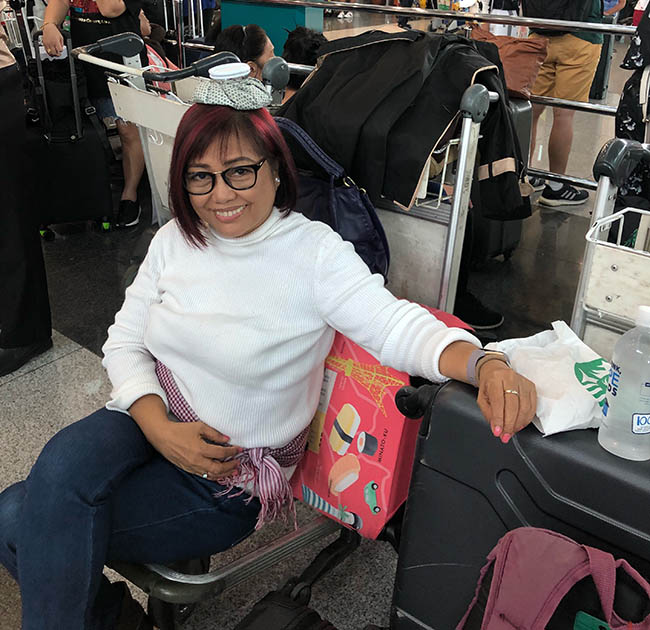
To reach that single step here in Germany took me almost three days  and whole lot of patience. I will write more about my adventure during the NAIA chaos which took off two days off my vacation plans.  I was travelling with my younger sister who has been so cool despite the chaos we were into.  I had to nurse a bump on my head when my husband accidentally closed the trunk door. Fortunately , it was just a slight bump that went away after the ice pack. (Smile)

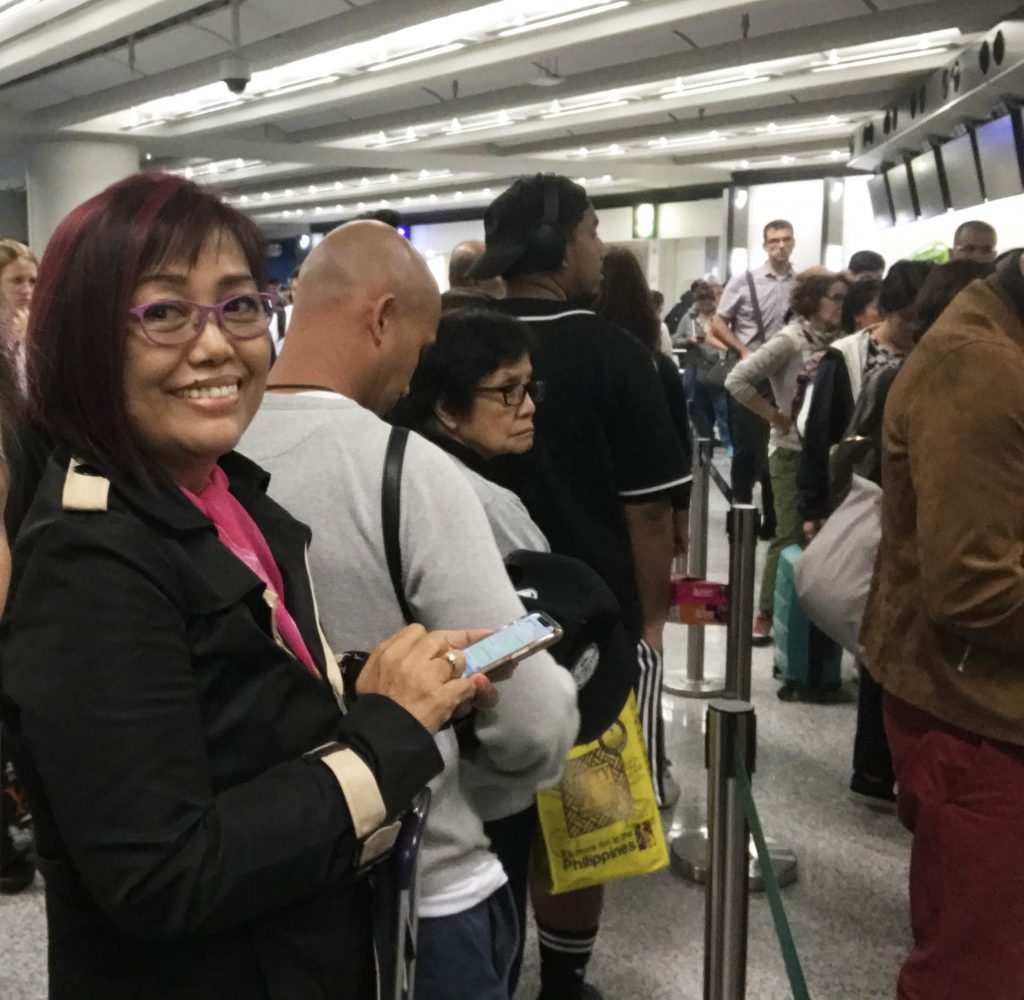
Take two at the NAIA Terminal 3, delayed for five hours  and I am still smiling because I am terribly excited to see my daughter and start my adventure with my sister. (Smile)

I arrived in Hongkong on Sunday only to miss our connecting flight to Amsterdam. Still smiling.

Fortunately I got access to an airport lounge which gave me some time to nap and have a shower. Still smiling.

The sunrise near the Amsterdam-Schipol airport is lovely. (Smile)

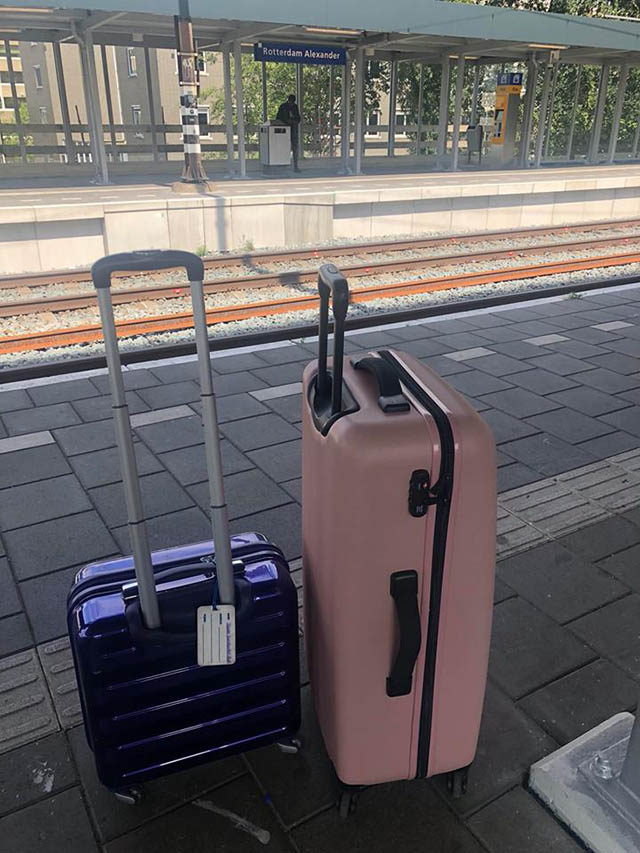
This is the first time ever that I am dragging a heavy luggage but the thought of seeing my daughter is enough to give me the strength. (Smile)

I am finally in her flat. Happy!

Yes, I am still smiling. A sunny day by the Rhine River  with my daughter is comforting. The flowers from her friend is pretty. All that adventure and living through the NAIA chaos is finally over. It was worth the trip no matter what route I took. (Wider smile this time)

So, yesterday I had time to sit in the park and reflect on the beauty around me. (Smile)

It was 25 Celsius in this part of Germany and wearing a hat is not just to protect me from the sun but also from the wasps or hornets. (Smile)

Even it is a bad hair day for me, I am excited to see Berlin. 34 years ago when I visited Germany, there was still a wall that  cut off West Berlin from virtually all of surrounding East Germany and East Berlin . Always smiling.

I will not allow chaos to ruin my vacation. Travel is taking a journey into myself and knowing that I can still enjoy what the universe has in store for me.  There are more smiles to show off.


This Family Media Plan was first posted at Manila Times

The American Academy of Pediatrics (AAP) developed an interactive, online tool so families could create a personalized Family Media Use Plan at HealthyChildren.org/MediaUsePlan

Meet two mothers who have different media plans for their kids. One mom of two girls aged nine and 10 years old says gadgets are only allowed on weekends. This is assuming they don’t have exams or a tremendous amount of homework. Also, they cannot use the gadgets the whole day as we “force” them to go outside and play. She also added that she is friends with her kids on Facebook, the only social network allowed. Her kids are hardly ever on Facebook so there is minimal monitoring. This mom also has access to their gadgets and Facebook. Their gadgets are synchronized to her gadgets so she knows what they download. She created their FB accounts so she knows their passwords. Their android tablets are also synched to her Google account.

Then there is another mother of two, aged nine and 13 years old, who doesn’t have weekday-weekend play and gadget rules. She allows her kids to use gadgets as long as they satisfy a grade requirement, which is no grade below B+ or 88. She is connected to them via Facebook but they hardly use it. They don’t have Instagram but have Twitter for school use.

family media plan

Like I discussed in my last column, “Are digital gadgets good for our children?”, parents play a role in guiding children and teens navigate the internet and media environment, just as they help them learn how to behave off-line. No one can decide the media plan for your family except the parent or caregiver but there are recommendations to give you an idea.

The American Academy of Pediatrics (AAP) recommend that parents or caregivers develop a family media plan that considers the health, education, and entertainment needs of each child and the whole family. Our family pediatrician told me that the Philippine Pediatric Society (PPS) follows the recommendations of the PPS.

Continue reading at the Manila Times

Are digital gadgets good for our kids? was first published at the Manila Times, July 29, 2018.

Most parents face this dilemma: should they be giving their kids gadgets as toys? Or should they deprive them of these gadgets? It doesn’t help that the World Health Organization (WHO) recently released the latest update of its International Classification of Diseases and identified gaming disorder as an addictive behavior disorder. The new classification is warranted because of a movement in the medical field to recognize addictive behaviors extend beyond drug addiction, according to John Roache, who heads UT Health San Antonio’s Division of Alcohol and Drug Addiction.

Having raised my three children in the early age of the internet in 1995, I followed two parenting concepts that applies online and offline. These are clear limits and lead by example.

Clear limits mean providing boundaries on our child’s activities and walking the talk on rules.

We need to understand the technologies better to know how they should and should not be used. We have to recognize where the real world begins and ends so we can help our children develop boundaries in both worlds. Parents also need to venture into the online world of our children to help them navigate the tricky waters, learn the rules, learn from our adult experience and still be safe.

In our digital lifestyle, a mobile phone or tablet is usually within easy reach. Raising tech-savvy kids at such a young age has its advantage but can also be a little worrisome. Both feelings are valid, but the motivation behind our children’s interaction with gadgets need to be examined as this can help determine whether the use of the gadget is beneficial or harmful to the kid. Children exposed to gadgets for more than two hours a day have higher risk of becoming overweight, which could lead to other serious illnesses such as diabetes and heart diseases according to Dr. Parolita Mission, head of the National Nutrition Council (NNC) in Region 7.

A paper “The Impact of using Gadgets on Children”, written by Sundus of the Department of Computer Science, Lahore Garrison University and which appeared in the “Journal of Depression and Anxiety” published on January 10, 2018 discussed both the positive and negative impact of gadget use. The positive impact of gadget use are 1) Children have better motor skills; 2) Gadgets are fun for kids while they use them; 3) Educational games help children to perform well in their studies; 4) Playing video games enhances their skills of competition and enables them to manage themselves in competing environment.

On the other hand, the negative impact of gadget use is Speech or language delay, Attention deficits, Learning problems, anxiety, childhood depression, and negative impact on character.

Mundus recommend some tips parents can follow when their child is using gadgets.

Set time for using screens: The amount of time children spend on gadgets need to be restricted and be consistent by not allowing them to use after their time is finished. It is recommended that small children use gadget an hour a day and two hours a day for school children. Set your own rules and follow them consistently.

Some parents get their children’s gadgets at 9:00 PM before bedtime while others programmed their modem to shut off at a certain time. Another parent I know allows her highschool children to monitor their own time as long as their grades are fine. The limits I set for my children below 16 years old: only one hour gadget use/internet a day. No TV during school days. Once the girls were in college, I set them free and allowed them to set their own rules.

Make them play outside: Children need to be encouraged to play outside with their friends and siblings. They will learn to interact and communicate with other children. Playing with pets like cats, dogs, and other kids are so much better, rather than watching any animated movie. Playing outside also helps in exercising long distance vision and lessens the chances of myopia. Allow them to develop other hobbies like singing, sports or the arts.

You can also make a deal in the house that for every hour of media, they must also spend an hour reading or being outside. This makes sure kids keep a balance between technology and other activities.

Gadgets as babysitters is discouraged: It is best to keep the children occupied with other creative toys, story books, puzzles, coloring books while you are busy. Kids should be experiencing all the senses in their activities not just eye-hand coordination.

Ensure adequate sleep of your child:  10 hours a day is what our young children need every day. Good sleep helps recover from eyestrain and for efficient working of brain.

If you need to use digital devices to your young children, cuddle them in your arms or sit them on your lap. The best way to make technology a healthy and positive part of family life is actually to embrace it as a family activity.

Play games along with them to encourage building social skills while monitoring how they are learning. Teach them how to use technology responsibly. Talk to them about apps that have added value, versus apps that are merely repetitive. For as long as the kids are guided well and follow a balanced set of online and offline activities, gadget use can be beneficial to their learning and growth. As with everything, moderation is key.

Helicopter parents take away a child’s character and his ability to do things on his own. This type of parenting is backfiring. – Lisa Hein

helicopter-parenting

I only heard of term, helicopter parenting from Cookie when I asked for suggestions on topics. I did a little research and found out that helicopter parents are so named because, like helicopters, they hover closely overhead, rarely out of reach, whether their children need them or not.

I wondered if I was so I asked Lauren if I was a helicopter parent because I knew at some point I was a protective and strict parent. She said “no”. Sometimes I think I am so laid back but I don’t think I was a helicopter parent except when it came to the internet usage. In 1996, there were very few kids online and I had no one to ask advice on web safety. I learned to let go when the girls were in college but I never hovered like a helicopter when it came to their academics. In fact, I never fussed about their grades except when they needed help on a topic. Part of growing up is learning to stand on their own. The girls knew we were always there to ask for help.

How can you tell if you are a helicopter parent? A parent shared me her article 10 ways to tell if you are a helicopter parent, ten signs that you’re well on the road to driving your children, and yourself, insane. What is disturbing is the results of a study that says ” overly protective parents might be leaving a lasting impact on their child’s personality.” The US study, which surveyed college freshman, is one of the first to try to define exactly what helicopter parenting is, and measure it.

Can you imagine what it will be like in the more conservative Philippine setting? Only 10 % of the students surveyed had helicopter parents. I think I saw a few during registration period in Ateneo when I fetched my daughter after she was done.

What did the study show?

“Students with helicopter parents tended to be less open to new ideas and actions, as well as more vulnerable, anxious and self-consciousness, among other factors, compared with their counterparts with more distant parents.”

“We have a person who is dependent, who is vulnerable, who is self-conscious, who is anxious, who is impulsive, not open to new actions or ideas; is that going to make a successful college student?”

Many educators have been searching for ways to tell parents when to back off. It’s a tricky line to walk, since studies link parents’ engagement in a child’s education to better grades, higher test scores, less substance abuse and better college outcomes. Given a choice, teachers say, overinvolved parents are preferable to invisible ones.

The challenge is helping parents know when they are crossing a line.

My advice is letting go slowly… starting at 8 years old, determine if your child can wean off from your tutorial time, decide extra curricular activities and even making decisions with your guidance. Remember , a certain amount of hovering is understandable when it comes to young kids, but when it persists through high school and college, I think it is so unhealthy for both sides.

‘Give ’em the morals, give ’em the right start, but you’ve got to let them go.’ They deserve to live their own lives.”

helicopter-mom

Image posted at take10withtricia.com and http://womenonthefence.com